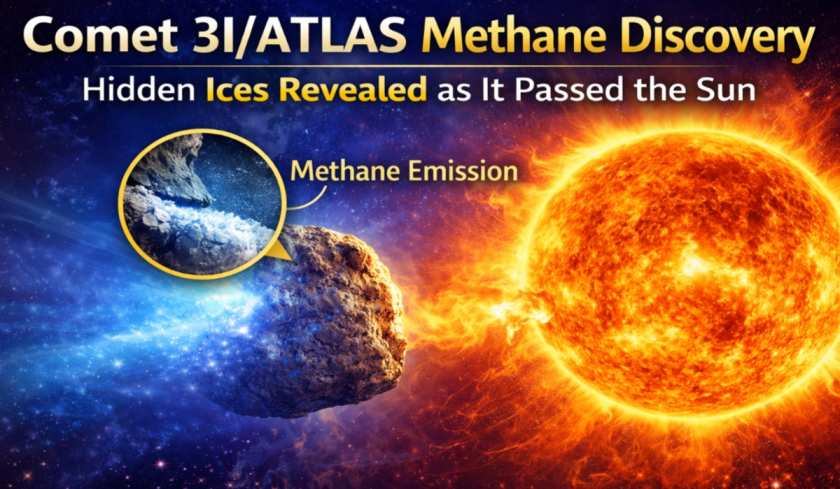
The Comet 3I/ATLAS methane discovery has become one of the most exciting space findings of 2026. Scientists observed that as passed close to the Sun, it began releasing methane gas—revealing hidden icy layers beneath its surface.
This rare observation is helping astronomers understand not only the composition of this mysterious interstellar visitor but also the conditions of distant planetary systems.
Why Did Comet 3I/ATLAS Release Methane?
As part of the Comet 3I/ATLAS methane discovery, researchers found that the intense heat from the Sun triggered a process called sublimation—where solid ice turns directly into gas.
When heated the comet:
- Surface ice began to vaporize
- Inner layers became exposed
- Methane gas was released into space
This methane was not just on the surface—it came from deep inside the comet, offering a rare glimpse into its internal composition.
How Scientists Detected Methane
The breakthrough in the Comet 3I/ATLAS methane discovery was made using advanced instruments on the .
Scientists analyzed mid-infrared light signals emitted by the comet and identified methane signatures. These signals revealed that:
- Methane emission increased as the comet approached the Sun
- The gas originated from previously hidden layers
- The comet’s outer surface may have lost volatile materials long ago
What Makes Comet 3I/ATLAS Special?
The Comet 3I/ATLAS methane discovery is even more significant because this object is not from our Solar System.
- It is an interstellar comet
- It has traveled across the galaxy for billions of years
- It is only the third known interstellar visitor
This makes it a valuable time capsule containing clues about other star systems.
Clues About Its Composition
Beyond methane, studies linked to the Comet 3I/ATLAS methane discovery have revealed:
- Presence of carbon dioxide
- Water ice in its nucleus
- Large amounts of water vapor released
Observations from and the confirmed that the comet ejects massive quantities of gas—equivalent to tens of Olympic swimming pools daily.
What Scientists Learned
The Comet 3I/ATLAS methane discovery provides key insights:
- Outer layers may have been altered in another planetary system
- Inner layers remained preserved for billions of years
- Heat from the Sun exposed ancient materials
This helps scientists understand how comets evolve across interstellar space.
Final Chance to Study Comet 3I/ATLAS
As the comet moves away toward the outer Solar System, observing it is becoming increasingly difficult. However, astronomers still hope to gather more data before it disappears forever.
The Comet 3I/ATLAS methane discovery may be one of the last major breakthroughs from this rare visitor.