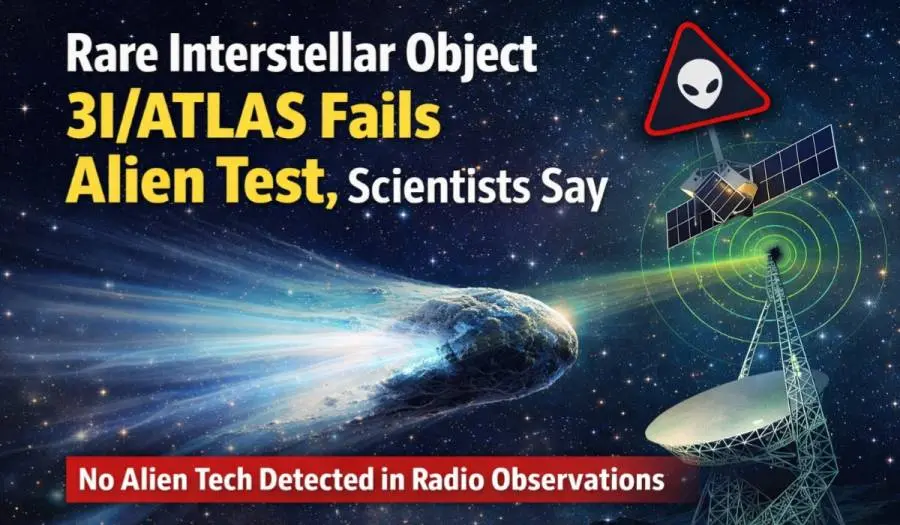
Rare Interstellar Object 3I/ATLAS has failed the alien technology test. Scientists found no techno signature during the most sensitive radio observations ever conducted.
Most sensitive radio observations of the Rare Interstellar Object 3I/ATLAS have been done by scientists and no traces of alien technology and artificial signals have been detected. This discovery is a strong indication that this alien object is a natural cosmic object and not a probe or a space vehicle of an advanced civilization.
Deep Radio Scans Reveal No Techno signature
The scientists employed the Robert C. Byrd Green Bank Telescope (GBT) in West Virginia which recorded radio signals in 100 meters to detect narrowband or artificial radio activity of Rare Interstellar Object 3I/ATLAS over a broad spectrum of frequencies (1–12 GHz). On 18 December 2025 (the day before the closest approach of the object to the Earth on 19 December 2025), when the telescope was sensitive enough to detect transmissions as weak as 0.1 watts or about the power of a mobile phone at that range), observations were made. However, the findings revealed no man-made emissions concentrated around the object and all the observed signals could be traced to man-made interference or other natural sources.
Data used by a major international project, Breakthrough Listen, to search for evidence of extraterrestrial intelligence, also used information collected by other observatories, such as the Parkes and MeerKAT radio telescopes. All of these extensive scans did not find technological fingerprints, or techno signature, that would point to technological life.
3I/ATLAS: A Rare Interstellar Visitor From Outside Our Solar System
It was discovered on 1 July 2025, and its odd hyperbolic orbit indicated that it was not of our solar system, which was the third object to be confirmed as an interstellar object after 1I/‘Oumuamua and 2I/Borisov.
Although there is a degree of public conjecture and even scientific disagreement, such as the assumption that some scientists might believe the object to be an alien probe, the astronomical opinion is so considerable that Rare Interstellar Object 3I/ATLAS is acting like a comet. It exhibits the common characteristics of comets including an icy nucleus, coma (cloud of gas and dust) and outgassing as it interacted with sunlight.
Images and information published by NASA and other space agencies have also indicated that comets are behaving normally, which only supports the perception that Rare Interstellar Object 3I/ATLAS is a natural object.
Why Studying Rare Interstellar Object 3I/ATLAS Still Matters
Although there were no alien signals detected, the study of Rare Interstellar Object 3I/ATLAS provides astronomers with a unique chance to obtain knowledge about the composition and features of material from other star systems. It assists scientists in understanding how these interstellar objects are created, developed, and how they interact with solar radiation as they pass through our cosmic environment.
No Evidence of Alien Technology
To conclude, although Rare Interstellar Object 3I/ATLAS looks like an exciting and fascinating discovery, with fringe theories of alien technology, the most profound radio observations to date indicate it to be a natural interstellar comet with potentially valuable scientific implications, but not a sign of intelligent life.