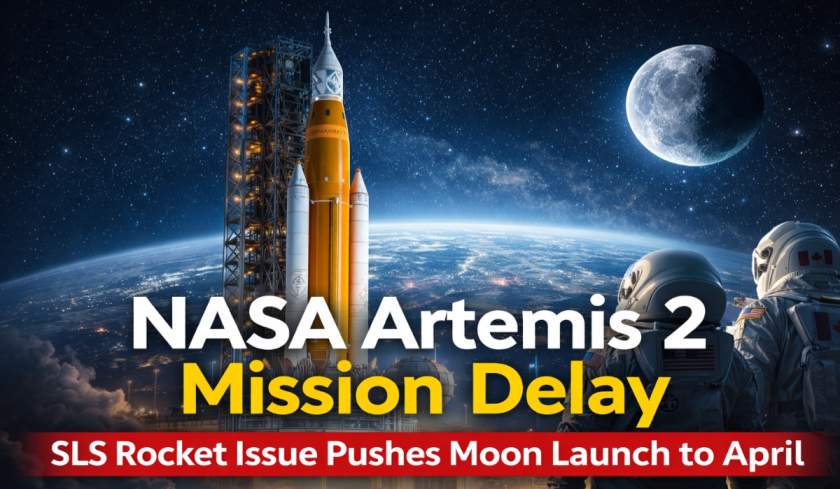
NASA Artemis 2 mission delayed again due to SLS rocket helium issue. Check new launch date, crew details, and latest Moon mission updates here.
The much-awaited NASA Artemis 2 Mission has hit another unexpected delay, creating buzz across the global space community. The powerful Space Launch System (SLS) rocket—designed to take astronauts back to the Moon—has encountered a helium flow issue, forcing NASA to pause its launch plans once again.
This development is trending worldwide as space enthusiasts eagerly wait for humanity’s next giant leap toward lunar exploration.
What Went Wrong with NASA’s SLS Rocket?
NASA engineers recently completed a successful wet dress rehearsal (fueling test), but soon after, a technical issue was discovered.
The problem:
- Interrupted helium flow to the upper stage
- Helium is crucial for maintaining pressure and stability in rocket fuel tanks
- Without proper helium flow, launch safety cannot be guaranteed
Because of this, NASA has decided to roll back the rocket to the Vehicle Assembly Building (VAB) for further inspection and repairs.
Artemis 2 Launch Date Delayed Again
Originally planned for February 2026, the launch had already shifted to March 6, 2026.
Now, due to the latest issue:
New expected launch window: April 2026 (earliest)
NASA officials have confirmed that March launch chances are now unlikely.
Why Artemis 2 Mission Is So Important?
The Artemis 2 mission is not just another spaceflight—it marks a historic moment:
- First crewed mission under NASA’s Artemis program
- Will carry 4 astronauts around the Moon
- First human deep-space mission since the Apollo era (1972)
- A major step toward future Moon landing (Artemis 3)
Artemis 2 Astronaut Crew
NASA has selected an elite international crew:
- Reid Wiseman (Commander)
- Victor Glover (Pilot)
- Christina Koch (Mission Specialist)
- Jeremy Hansen (Canadian Space Agency)
Interestingly, due to the delay, the crew has exited quarantine and will resume training until a new launch date is finalized.
Rocket Rollback: What Happens Next?
NASA will now:
- Move the SLS rocket from Launch Pad 39B
- Transport it back to the Vehicle Assembly Building (VAB)
- Perform detailed inspection and fixes
This rollback process itself is massive—it takes hours to move the 322-foot rocket.
Artemis Program: The Bigger Vision
NASA’s Artemis program is more than just a mission—it’s a long-term vision:
- Return humans to the Moon
- Build a sustainable lunar base
- Use Moon resources like water ice
- Prepare for future Mars missions
What Will Artemis 2 Actually Do?
Unlike future missions, Artemis 2 will not land on the Moon.
Instead, astronauts will:
- Travel around the Moon for ~10 days
- Go 4,700 miles beyond the far side
- Test Orion spacecraft systems
- Return safely to Earth
This mission is crucial before attempting a real Moon landing in Artemis 3.
Why Delays Are Still a Good Thing
While delays may frustrate space fans, they are actually critical for safety:
- Human lives are involved
- Complex systems must work perfectly
- Even minor issues can cause major failures
NASA prioritizes “safety over speed”, which is why such delays are common in space missions.