



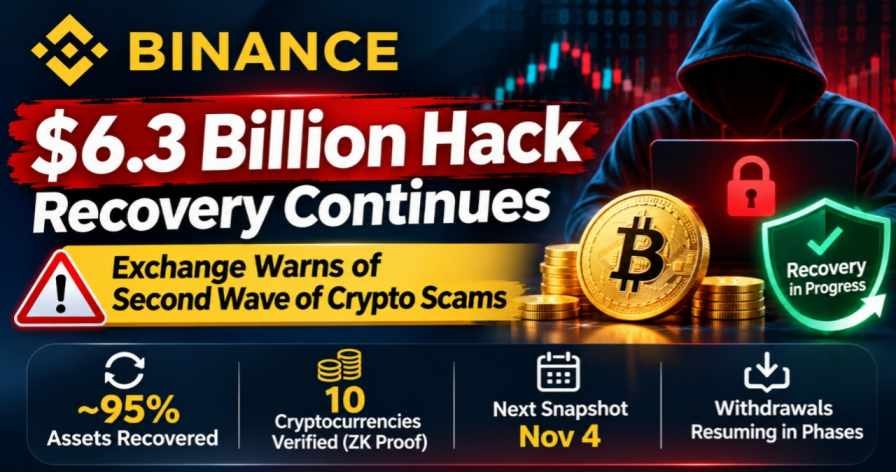
Binance $6.3 billion hack recovery continues as scammers target users with fake withdrawal support. Check the latest security warning and reserve proof update.
Currently, Binance’s hacked assets are being recovered, and the crypto scam alert is now on the rise.As Binance’s hacked assets are being recovered, the crypto scam alert is gaining momentum.
Binance’s $6.3 billion hack recovery is in a new stage, and the world’s largest crypto exchange is now alerting users to a second round of cryptocurrency theft. Previously, scammers have been seen to target customers with fake withdrawals services messages, bogus withdrawals recovery offers, and fake wallet authorizations.
Binance released a security advisory on November 2 saying that the delayed withdrawal reopening presented a risk to attackers who might try to trick users waiting for their withdrawals to the crypto exchange.
The Binance $6.3 billion hack has also sparked doubts about the security of exchanges, customer protection and the need to double-check cryptocurrency reserves. At the same time, Binance claims to have finalized verification of a major reserve snapshot for ten cryptocurrencies using a zero-knowledge proof.
The exchange continues to refresh the assets impacted by the security incident that was reported on Oct. 29, and users are cautioned to be wary of suspicious communications.
The Binance $6.3 Billion Hack: Key Highlights
The Binance $6.3 Billion Hack: Key Highlights:
- Binance has issued a warning on fraudulent withdrawal assistance and cryptocurrency recovery scams.
- The exchange is slowly resuming withdrawal services after the reported attack on October 29.
- Binance states that around 95% of the lost tokens have been replaced.
- Ten top cryptocurrencies have had a zero-knowledge proof of reserves completed.
- There was another withdrawal reopening phase planned for November 3.
- A new snapshot of more cryptocurrencies is scheduled for November 4th.
Binance Alerts Users to Another Crypto Theft Scam
Binance issues a reminder to users regarding another crypto scam.
As the Binance hack leads to $6.3 billion in cryptocurrencies to be potentially lost, it has also opened the door for scams to target cryptocurrency investors with delayed withdrawals.
The security advisory states that fraudsters can pretend to be Binance employees or customer support through emails, private messages, group chat, etc.
These criminals can promise to help users recover their funds, or to accelerate pending withdrawals.
These are some of the scam techniques reported:
- Providing paid priority withdrawals queues.
- Demanding charges to unblock cryptocurrency withdrawals.
- Assurance that the security incident will not impact the compensation offered to users.
- Promoting bogus cryptocurrency recovery services.
- Distribution of fake PoR sites.
- Prompting users to move cryptocurrency to what they purport to be secure wallets.
Binance has stressed to users that they should never pay people claiming to unlock withdrawals or to recover assets via unofficial methods.
The exchange also cautioned that new tools for reserve verification may be increasingly misleading in terms of fraudulent compensation links and fake verification sites.
Withdrawal Delays May Pose Risks to Crypto Scams, Here’s Why
The longer cryptocurrency withdrawals are delayed, the more investors might be exposed to messages offering them immediate access to their investments.
This uncertainty is exploited by scammers and they use it to create a sense of urgency. They might state that the user’s exit will be revoked if they don’t finish a payment or wallet authorization.
With this caution about a $6.3 billion hack warning, Binance customers who haven’t been directly involved in the hack can still face some extra risks.
Do not trust any messages that tell users about withdrawals; they must check all withdrawal details on Binance’s official Messenger or website.
Binance Cautioning On Unwanted Permissions For Wallets
Binance security warned about malicious wallet permissions is one of the most critical risk.
Fraudsters might trick cryptocurrency holders into logging in to fake websites or authorizing unusual transactions.
If a user has given the same dangerous permissions to an evil smart contract, the attackers can move the assets without getting another approval from the victim.
This is one kind of cryptocurrency theft that can be extremely detrimental as blockchain transactions are irreversible.
Binance has cautioned customers not to approve any transactions from unknown wallets, or sign requests from untrusted websites.
Important Security Advice
Don’t disclose to anyone your private keys or wallet recovery phrase. Avoid trading with sites you don’t recognize, and pay attention to each time acceptance.
Binance Has Finished the Audits for 10 Cryptocurrencies Using the Zero-Knowledge Proof of Reserves Method
The Binance hack, in which $6.3 billion was stolen, is ongoing, and the exchange has been making strides towards its proof-of-reserves verification system.
Binance announced the completion of a zero-knowledge proof (ZKP) to produce its reserve snapshot for October 31 on Nov. 2.
The verification enabled customers to validate their account balance had been part of the snapshot and their money had been backed up by matching reserves, but did not make it public to see how many holdings each customer had.
The cryptocurrencies that are verified are:
| Cryptocurrency | Symbol |
|---|---|
| Bitcoin | BTC |
| Ethereum | ETH |
| BNB | BNB |
| XRP | XRP |
| Solana | SOL |
| Zcash | ZEC |
| Tether | USDT |
| USD Coin | USDC |
| World Liberty Financial USD | USD1 |
| Ripple USD | RLUSD |
The reserve verification confirms that at least 1:1 backing of the covered customer balances of the snapshot were maintained, according to Binance.
The verification, however, is only for the balances as on 00:00 UTC on October 31.
It should not be viewed as an indication of the Exchange’s current financial status or provide a full independent review of its overall financial strength.
How Binance Users Can Verify Their Crypto Reserves
Binance states that users can check for themselves if their balances were part of the snapshot of the binary reserve.
There are two stages to this process: first, gathering the verification data for the specific account; and second, applying the verification tool that the exchange has published on its official proof-of-reserves website.
The user must log in to the verification system from Binance’s official website.
It is more important than ever to be transparent after the Binance $6.3 billion hack, but investors need to know that proof of reserves is not the same as a full financial audit.
Binance Reveals that 95% of Affected Assets Recovered
Another big milestone in the Binance $6.3 billion hack recovery process has been the exchange’s progress in restoring the hacked assets.
Binance says about 95% of the affected assets have been replaced with company funds.
The rest of the 5 percent is allegedly made up of less liquid cryptocurrencies that aren’t easily available in large numbers.
Binance has been buying them up on the market and over-the-counter.
The exchange has also said that the replacements for lost assets is a different process from recovery and tracing the original stolen currency.
This is significant because in many cases the assets may have been replaced, but the original assets may not have been recovered.
This distinction is significant since the original money does not necessarily be recovered when the assets are replaced.
It is reported that customers have regained between 94% and 98% of their assets, which could help to build some degree of confidence in customers, but the incident has left questions about cryptocurrency exchange security.
Binance Withdrawal Services Will Gradually Resume
Binance Withdrawal Services will resume gradually.
Since the reported attack on October 29, Binance started restoring cryptocurrency withdrawals on November 1st.
The reopening is being rolled out in stages, depending on the supported cryptocurrencies and blockchain networks.
The latest update says that another withdrawal restoration phase is set to take place on November 3.
That phase wasn’t confirmed with specific blockchain networks and cryptocurrencies in the source report, however.
The withdrawal delays will still be experienced by some customers because of the phased reopening.
Binance has recommended users to verify suspicious communications via its official verification service and to check the status of their withdrawals directly from the official application.
The Binance $6.3 billion hack has illustrated the possibilities of withdrawal delays being a scam method for those looking to get the better of cryptocurrency investors.
Binance Announces Another Proof of Reserves Snapshot
In addition, Binance is preparing another reserve snapshot to enhance transparency.
The exchange says it will release a new snapshot on November 4 that will include more cryptocurrencies.
It will take around 40 to 50 hours to generate the accompanying zero-knowledge proof.
The additional verification may provide customers with more information about the exchange’s reported reserves.
However, users will still need to remain vigilant about the difference between reserve verification, asset replacement and actual cryptocurrency recovery.
The various processes are in themselves distinct, and advancement in one does not necessarily indicate advancement in the others.
The Binance $6.3 Billion Hack Explained: How It Affects Crypto Investors
There are some valuable takeaways for cryptocurrency investors after the Binance $6.3 billion hack.
While an exchange is making efforts to restore services, investors can also be subjected to further risks due to fraudulent communication and malicious wallet approvals.
The incident also serves as a reminder of the significance of comprehending the methods of cryptocurrency exchanges in securing customers’ assets and communicating during security emergencies.
Here are some precautions investors should take into account:
- Do not follow any other channels to get information about withdrawals.
- Do not pay any fees to a stranger who promises quicker withdrawals.
- Do not reveal private keys or recovery phrases.
- Refuse new permissions of unknown smart contracts.
- Confirm cryptocurrency reserve details by official tools.
- Avoid bogus compensation claims and recovery firms.
Overall, the Binance hack recovery process is a significant event in the cryptocurrency sector, especially with growing demands for security and transparency from exchanges.
Frequently Asked Questions (FAQs)
1. The Binance Hack of the $6.3 Billion Was What?
The report provides details of Binance’s security incident on October 29, 2026, which resulted in the theft of $6.3 billion in cryptocurrency from the company’s hot wallet system. The exchange then started to resume withdrawals and increase damaged assets.
2. Will Binance Get the Stolen Cryptocurrency Back?
Binance says it has used company funds to restore about 95% of the assets and is currently restoring 5%. This doesn’t necessarily imply that the initial stolen cryptocurrency has been recovered.
3. What Are the Scams That Binance Has Alerted Users About?
Binance has issued warnings to customers about fake customer support representatives, fake customer support calls seeking payment for a withdrawal, fraudulent claims for compensation, fake websites that claim to be proof of reserves and malicious wallets that request authorization.
4. Does Binance Fee You to Withdraw?
The security advisory mentioned in this report states Binance does not require any fees for the unlocking of withdrawals and doesn’t have paid recovery services. It is recommended that users refrain from unofficial recovery offers.
5. What Is Binance’s Zero Knowledge Proof of Reserves?
The zero-knowledge proof of reserves is a cryptographic verification method that enables users to verify specific information about their account balances and reserve backing without providing the public with details about specific account balances.
6. What Cryptocurrencies Does Binance Have in Its Reserve Verification?
The snapshot reported on Oct. 31 is for BTC, ETH, BNB, XRP, SOL, ZEC, USDT, USDC, USD1, and RLUSD.
7. What Will Be Binance’s Next Move?
Binance started to resume withdrawals on November 1, and another phase is expected on November 3. Supported assets and the blockchain networks will dictate when full restoration will happen.
8. What Are the Risks Associated with Investing in Cryptocurrencies on Binance?
Users should ensure that they are reading official announcements, are not clicking on suspicious links, are not providing private keys or recovery phrases, and thoroughly check wallet permissions before confirming transactions.